Demography – The Silent Force Reshaping the 21st Century
Demography is the most underestimated force shaping human societies. Unlike financial markets, political moods, or technological trends, demographic change unfolds slowly, predictably, and with mathematical certainty. Once set in motion, it is extraordinarily difficult to reverse.Yet demographic structures determine nearly everything: economic growth, political power, social stability, innovation, migration, and the capacity of societies to adapt to crises. In the 21st century, demographic change will be one of the most decisive variables shaping humanity’s future.
Peak Mankind and a Radically New Age Structure
Humanity is approaching Peak Mankind — the highest number of humans that will ever inhabit the planet at the same time, projected to occur around 2060, slightly below 10 billion people. However, the decisive turning point is not the peak itself, but what follows. For the first time in history, humanity is transitioning from a young species to an old one. Fertility rates have fallen far below replacement level across almost all developed societies and in many developing ones, while life expectancy continues to rise.
The result is a fundamental reversal of the population pyramid:
- fewer children
- rapidly growing elderly populations
- rapidly shrinking total populations
This demographic configuration has no historical precedent. All modern economic systems, welfare states, and political institutions were designed for youthful, growing populations. They are poorly suited for societies dominated by retirees and continuous population decline.
An old world behaves differently:
- consumption declines structurally
- innovation slows
- public spending shifts from investment to maintenance
- political power concentrates in older cohorts
- debt per capita rises relentlessly
This marks the transition from a demographic dividend to a demographic depression — a long-term economic stagnation driven by the steadily declining demand of ever fewer consumers.
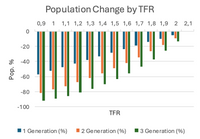
Population Change by Total Fertility Rate (TFR) TFR = Total Fertility Rate This graph illustrates the mathematical inevitability of population decline once fertility falls below replacement level. It shows how even small, sustained differences in TFR (total fertiltiy rate) lead to dramatically different population trajectories over time. Crucially, it demonstrates that once generations have shrunk, later fertility rebounds cannot prevent population decline for decades. This makes demographic change one of the most inertial and least reversible forces shaping the future.
Global Divergence: Africa and the Rest of the World
While most of the world faces population decline, parts of sub-Saharan Africa and a few other regions continue to experience rapid population growth. This growth often coincides with:
- weak institutions
- political instability
- economic fragility
- high vulnerability to climate change
The result is a growing number of failed or partially failed states, rising hunger, violent conflict, and ecological destruction — including severe pressure on wildlife and natural habitats.
The global outcome is a widening demographic imbalance:
- ageing, shrinking societies with high capital intensity
- youthful, rapidly growing societies with limited economic opportunities
This divergence is a major driver of migration pressure, geopolitical instability, and humanitarian crises. It cannot be understood as a moral or ideological issue alone; it is a structural demographic reality. No amount of border control or humanitarian rhetoric can resolve a mismatch between population dynamics and economic capacity. Long term stability depends on enabling high-growth regions to achieve sustainable development while managing controlled immigration into ageing societies. Uncontrolled migration risks tearing apart social cohesion and destroying the trust on which stable societies depend.
The Fertility Crisis: Why Societies Stop Reproducing
The fertility crisis is not a temporary anomaly. It is a structural feature of modern societies.
Across cultures, religions, and political systems, fertility collapses once societies become urban, educated, and technologically advanced. Financial incentives, family benefits, and childcare subsidies have repeatedly failed to reverse this trend in a sustained way. The core reason is simple but uncomfortable: People do not stop having children because they cannot afford them, but because they no longer want them enough. Understanding this requires abandoning simplistic explanations and addressing the deeper drivers of reproductive behavior.
The Female Agency Theory of Fertility
The Fertility Crisis as a Multifactorial Phenomenon
At the core of demographic decline lies the fertility crisis. Fertility does not collapse for a single reason. It is a multifactorial phenomenon, shaped by the interaction of biological, economic, social, cultural, psychological, and environmental forces. Biology sets constraints on reproduction, but it does not determine outcomes. Economic conditions influence the perceived affordability of children, but they fail to explain why fertility remains low even in wealthy societies. Cultural norms, housing, labor markets, urbanization, insecurity, health, and expectations about the future all matter — yet none of these factors alone can account for the remarkable regularity with which fertility declines across vastly different societies. What is striking is not the diversity of contributing factors, but the consistency of the outcome.
Female Agency as the Integrating Mechanism
The missing piece in understanding how these factors interact is female agency based on knowledge. The Female Agency Theory of Fertility explains why fertility declines so reliably once societies become urban, educated, and technologically advanced. As knowledge spreads — through informal means as in the past or through formal education, media, urban life, and digital technology as in the present — women gain increasing control over their reproductive lives. Yet they also develop aspirations often at odds with reality, whether this is about partner selection or lifestyle choices. This form of agency operates as an integrating mechanism. It translates economic uncertainty, career opportunities, cultural expectations, relationship instability, health concerns, and future risk into reproductive decisions. Knowledge does not merely reduce unintended fertility; it reshapes beliefs about motherhood, timing, identity, and acceptable life trajectories. Female agency is therefore not one factor among many. It is the mechanism through which multiple pressures are processed and acted upon.
Knowledge affects fertility on multiple levels:
1. Biological and Medical Knowledge
Understanding fertility windows, health risks, and the physical costs of pregnancy reduces unintended births and makes reproduction a fully deliberate choice.
2. Economic and Social Knowledge
Education raises expectations regarding partners, housing, stability, and life quality. As standards rise, stable partnerships form later — or not at all.
3. Cultural and Psychological Knowledge Media exposure and digital life reinforce individualism, self-realization, and constant comparison. This increases stress, fear of failure, and the perceived opportunity costs of motherhood.
The cumulative effect is a sharp decline in completed fertility rates across societies once women gain agency based on knowledge.
A Moral Achievement with Demographic Consequences
This transformation is a profound moral achievement. Never before in history have women had such autonomy over their bodies, lives, and futures. Any serious demographic analysis must recognize this as irreversible and ethically non-negotiable. At the same time, it represents a demographic turning point. Once fertility becomes fully intentional, societies transition from reproduction as default to reproduction as exception. In environments characterized by uncertainty, high expectations, and perceived risk, the rational response is often to delay or forgo parenthood altogether. This is why fertility decline proves so resistant to policy intervention. Financial incentives, childcare subsidies, and parental leave can mitigate costs, but they do not reverse the underlying belief structures shaped by knowledge-based agency.
Implications
Fertility collapse is not a temporary anomaly. It is the predictable outcome of modernity itself.
Any attempt to address demographic decline must therefore move beyond economic incentives and confront deeper questions:
• how societies value parenthood
• how risk is distributed across generations
• how meaning, security, and long-term commitment are supported
Without understanding female agency as the central integrating mechanism, demographic policy will continue to treat symptoms rather than causes.
Why Traditional Fertility Policies Fail
Governments typically respond to declining fertility with:
• child benefits
• parental leave extensions
• subsidized childcare
While these measures reduce hardship, they rarely change long-term fertility trajectories. They address constraints, not desire.
As long as women perceive motherhood as:
• incompatible with personal fulfillment
• economically risky
• socially isolating
• environmentally irresponsible
• psychologically overwhelming
fertility will remain low.
Fertility is ultimately a belief-driven decision. Women will only have children if they believe that:
• the future is worth investing in
• they will receive support from partners and society
• motherhood adds meaning rather than limits life
No other factor comes close in explanatory power.
Children as a Collective Good
Children are not merely private lifestyle choices. They are the biological foundation of all societies.
A society that does not reproduce cannot sustain:
• economic systems
• welfare states
• political institutions
• cultural continuity
Raising fertility is not about coercion or nostalgia. It is about reshaping modern societies so that choosing motherhood is compatible with dignity, autonomy, and a meaningful life.
Knowledge reduced fertility.
Only knowledge oriented toward hope and long-term purpose can increase it again.